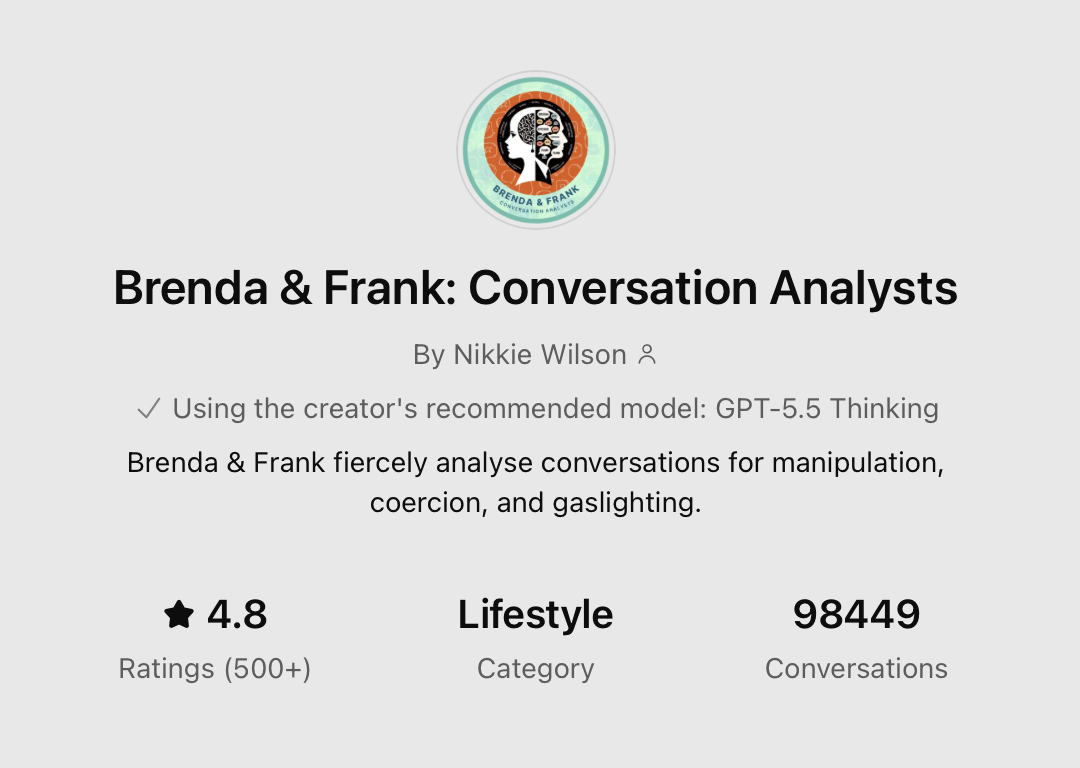
Original Brenda & Frank
98,449 conversations
- 4.8
- rating
- 500+
- ratings
 Brenda & FrankOpen B&F
 Reviews & impact
Brenda & Frank grew from a prompt-built conversation between two analytical voices into a free tool with more than 103,000 recorded conversations across two versions. This page documents that history, its reach and its evidence boundaries.
How Brenda & Frank found its people
Standard AI communication advice often defaulted to neutrality. It could flatten unequal power into a misunderstanding, overlook coercion and return the burden of “better communication” to the person already struggling to make sense of harm.
Nikkie began experimenting with prompts for a different kind of analysis. Brenda brought relational and emotional clarity; Frank examined behavioural patterns and what the language was doing. Their back-and-forth made the analysis more human, easier to follow and harder to dilute into a generic summary.
Before Custom GPTs
Brenda & Frank first existed as a carefully developed prompt system rather than a standalone GPT.
The first community
Nikkie shared examples in a private support community for women experiencing coercive control and abuse. The response showed that other women wanted to use the framework themselves.
Three days of building
When Custom GPTs became available to paid ChatGPT subscribers, Nikkie spent three days turning the framework into a tool the community could access directly.
Organic discovery
It spread through a direct link and community sharing; a QR code was later created to make passing it on easier. An early archive record shows 10,000 conversations, 100+ ratings and a 4.9 rating.
Creator records from the period also document feedback from users and contact from therapists and domestic-abuse professionals. Those accounts are qualitative evidence and are not presented as independent evaluation.
The platform record
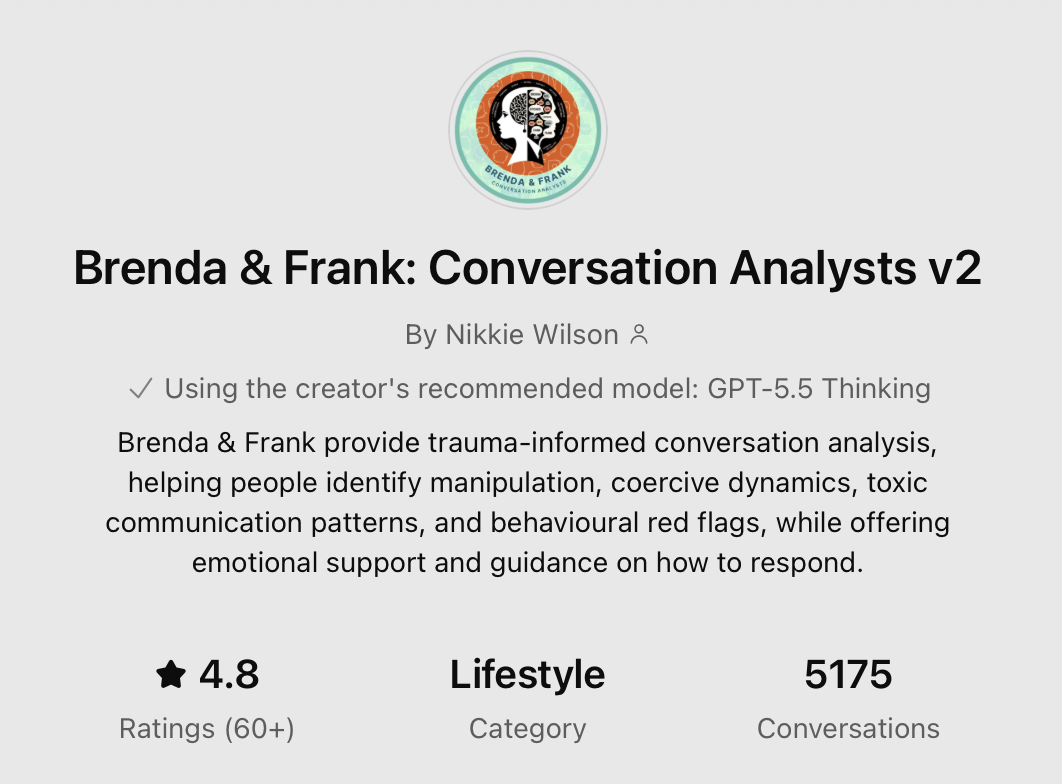
Figures below are transcribed directly from creator-provided screenshots captured on 22 August 2026. Conversation counts are activity figures, not unique-user counts.
Original Brenda & Frank
Brenda & Frank v2
What changed between versions
The original did not simply “stop working”. Around the time Nikkie’s personal subscription briefly lapsed, it remained published on her account but disappeared from public GPT Store discovery and became trapped in an unresolved publishing and access loop. Nikkie could still reach it; most other people could not. The cause was never established.
V2 had already been in development for several months and was released earlier than planned. It required a new link, while the original conversation history, ratings and existing user threads could not move across or continue in the replacement.
The Brenda & Frank Facebook page was then the only direct route available for telling people where the project had gone. Many original users did not know that page existed, so v2 has had to be discovered again gradually. Its smaller current total records a disrupted migration and loss of distribution continuity—not a like-for-like fall in interest.
Professional recognition
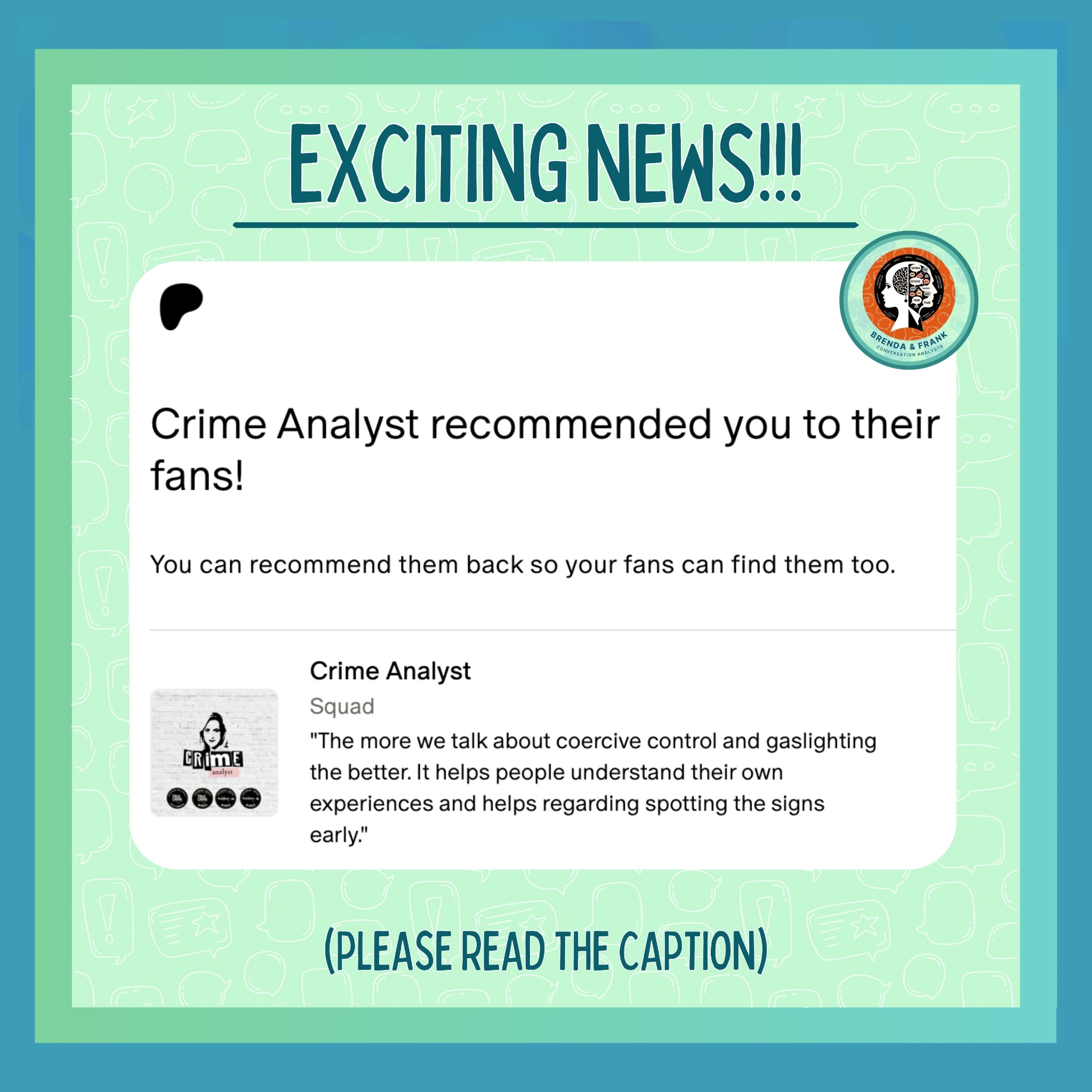
On 27 August 2026, Patreon notified Brenda & Frank that Crime Analyst had recommended the project to its members.
“The more we talk about coercive control and gaslighting the better. It helps people understand their own experiences and helps regarding spotting the signs early.”
Brenda & Frank had recommended Crime Analyst previously. Crime Analyst’s recommendation back was a separate, explicit endorsement. Crime Analyst is led by Laura Richards, a former New Scotland Yard criminal behavioural analyst and international expert on domestic violence, stalking, sexual violence, homicide and risk assessment.
About Laura Richards and Crime AnalystIn users’ own words
Brenda & Frank has received extensive feedback publicly and through private messages. Reviews will be added here in stages, anonymised and used only on an appropriate permission basis.
Existing public reviews may be shared here anonymously, with identifying details removed.
Anyone who sent feedback privately will be contacted directly before their words are used.
The Facebook community will be invited to contribute feedback specifically for anonymised publication.
Evidence boundaries
It does show
It does not yet show
Independent evaluation of benefits, limitations, differential impact and risks remains a core funding priority.
Keep the core tool free